Bee and the Horse
The Academic Art of Riding Blog by Bettina Biolik
Rest promotes learning

Rest promotes learning
A common feedback on my clinics is that participants are amazed by the amount of rest the horses are allowed in between exercising and that it seems to help them make a fast progress.
In fact, rest is important for both the human and the horse. We might have a quick grasp on a task intellectually but we still have to form new neural pathways to perform it well.
A study carried out by Leonardo G. Cohen, M.D, and colleagues of the National Institutes of Health, Bethesda, Maryland USA, shows that the resting brain repeatedly replays compressed memories of what was just practiced. In the study, volunteers were asked to learn a new skill (piano scales) while in a functional MRI, which allows researchers to map brain activity during the learning process. They found that rest seems just as important as practice itself.
“Our results support the idea that wakeful rest plays just as important a role as practice in learning a new skill. It appears to be the period when our brains compress and consolidate memories of what we just practiced.” (Leonardo G. Cohen, M.D)
While horses’ brains show some important differences to human brains, we are both mammals and our brains are similar enough to assume that this is also what happens in horses’ brains when they learn a new skill. As far as I know, it is not possible yet to put horses in a functional MRI while they are alive, just the severed head after death. (But I also remember reading that this might be possible soon).
What does this mean for our training?
We need more breaks.
Now think about a regular dressage training session. From the moment the rider gets on to the moment when the training is finished, often after a very long 45 or 60 mins, the horse is asked to move, move, move, and to perform one exercise or arena pattern after the other. If rest is allowed, the horse needs to keep moving in walk.
How often do you see riders just stand with their horses, without interacting with them, so the brain has time to replay what was just practiced? And to wait until the horse is finished processing?
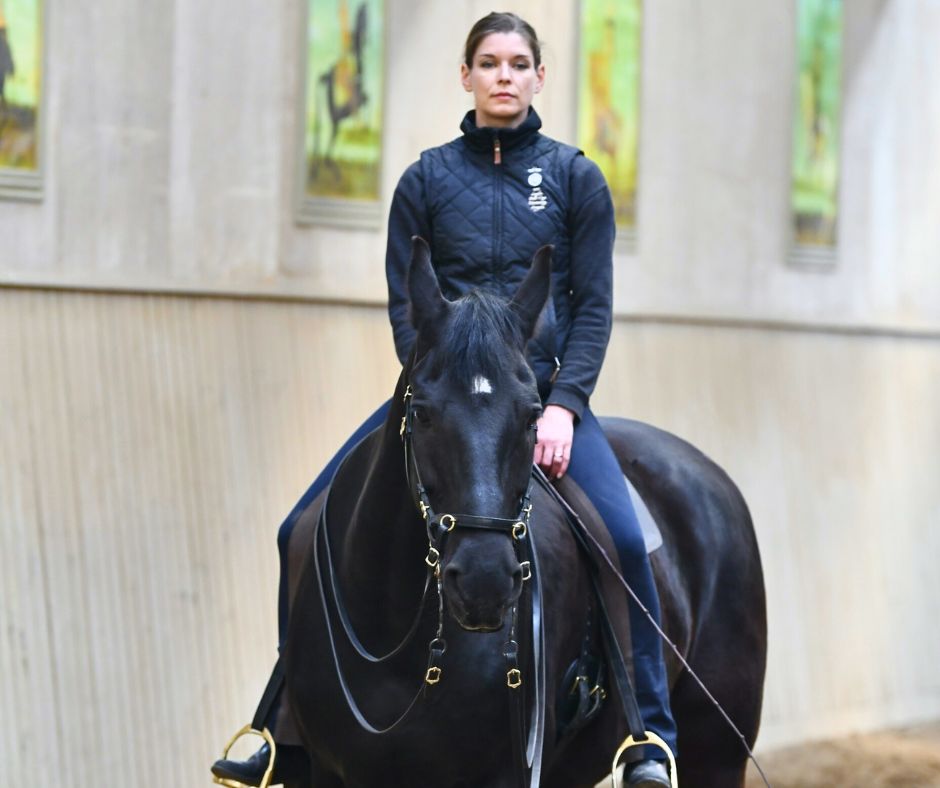
During my first internship at Bent Branderup’s place in Denmark, I noticed that Bent had a different way of structuring the lessons as I was used to. He asked me to take lots of breaks, actually asked me to “take a break and tell the horse he was good”. While the horse was standing, he continued to talk to me and told me about the biomechanics background of what we just practiced. While I listened, my horse could stand and process. I had never made so fast progress in the training in my life. While it was certainly also due to Bent’s excellent teaching, today I know that taking frequent and long enough breaks is an important factor as well.
Here is the link to the study if you are interested: https://www.cell.com/cell-reports/fulltext/S2211-1247(21)00539-8?_returnURL=https%3A%2F%2Flinkinghub.elsevier.com%2Fretrieve%2Fpii%2FS2211124721005398%3Fshowall%3Dtrue
Picture of Weto and I during lessons with Bent. I’m listening and Weto has time to process.

 Bee and the Horse