Bee and the Horse
The Academic Art of Riding Blog by Bettina Biolik
The Knighthood of the Academic Art of Riding
I would like to tell you a bit about the Knighthood of the Academic Art of Riding. Because some of you might have never heard of it, some might think “what a strange elite club”, and some might imagine it to be old-fashioned and out-dated. After all, …knighthood…seriously? 😉
This will be a longer one, so grab a cup of something 🙂
Let me start by telling you how and why the Knighthood came into being.
Because, despite the name, it was not founded by a group of people in velvet cloaks who met secretly by candlelight and decided that modern riding needed more swords. The Knighthood grew from Bent Branderup’s wish to bring together riders who regard dressage not merely as a method of training horses, but as an art, and who want to study, preserve and develop that art together. Its purpose was never simply to produce riders who could perform certain exercises. It was to create a living community centred around a shared ideal: using dressage for the horse, striving for a high level without disregarding nature, and giving both horse and human a meaningful task that can accompany them for many years.
The Knighthood of the Academic Art of Riding was founded by Bent Branderup in 1997. Today, it is an international academy devoted to research and education, whose members have demonstrated a defined level of practical skill as well as their commitment to its shared ethical principles.
Currently, the Knighthood has members from 21 countries, most of them in Europe, but reaching as far as South Africa and the United States. If I remember correctly, we are about 340 members.
How can one become a member?
The first step is the groundwork and longeing test. Here, the applicant presents a horse of at least five years of age, first in groundwork and then on the longe. The test includes the basic lateral movements, changes of bend, transitions between forward and collection, half-pirouettes, halts and transitions between the gaits, including canter. But the judge (Bent) is not merely ticking exercises off a list. The applicant must show good communication with the horse, clear and understandable aids, and the ability to recognise and improve the horse’s suppleness, shape, balance, tempo, rhythm and schwung. The exercises are performed away from the wall, so the wall cannot quietly take over the job of the trainer.
Passing this test does not yet make you a member. It makes you an applicant for the Squire test – which is where you are asked to demonstrate the same principles from the saddle.
The Squire test is primarily a test of the seat. The horse must be at least seven years old, and the rider must show that the seat is the primary aid while the reins, legs and whip remain secondary. The choreography includes shoulder-in, quarter-in, travers, renvers, half-pirouettes, changes of bend, collection and forward movement in both walk and trot, as well as balanced transitions into and out of canter. Again, the movements are ridden away from the wall.
This may be called the entry level of the Knighthood, but “entry level” should not be confused with “easy.” It represents a very high level of practical skill. The rider must not only be able to perform a considerable number of exercises, but must understand their purpose, connect them meaningfully and adapt the aids to the horse in front of them. Most importantly, the horse presented in the test must have been trained by the applicant. A polished performance alone is therefore not enough; the judge is looking at the education behind it and whether the rider has the knowledge to train a horse independently.
For many riders, passing the Squire test is consequently a deeply meaningful achievement: the result of years of learning, questioning, practicing, getting things wrong, trying again and gradually becoming more capable of helping the horse. Members describe joining the Knighthood with pride, but also with humility – because passing the test does not suggest that the learning is finished. It means that you have reached the level at which you are officially allowed to continue learning in very accomplished company. It’s only the start of an incredible journey.
Becoming a Squire is not a matter of passing one test, polishing your silver pin occasionally and living happily ever after.
A test shows your knowledge and skill at a particular moment in time. The Knighthood therefore follows a five-year rule: within five years, an active member is expected either to progress to the next examination or to repeat an examination already passed. For a Squire, the intended next step is the first Gold Ring test – the Bending of the Haunches – but repeating the Squire test is perfectly acceptable. The important point is to show that the level of practical skill has at least been maintained.
I find this an important part of the idea behind the Knighthood. Membership is not meant to preserve one glorious moment from many years ago. We and our horses change, our understanding develops, and sometimes life rather thoroughly rearranges our training plans. And, in fact, the whole Knighthood is changing, too. The aim is to keep learning, keep questioning and, ideally, continue towards the higher examinations.
There are, of course, situations in which taking a test within five years is genuinely impossible. A horse may become injured, a suitable horse may not yet be ready (the gold ring tests require a horse of 10 years of age), or life may have produced one of its less elegant half-halts. In that case, the member may ask the Round Table for a dispensation.
This means asking for an extension of one year and briefly explaining why it is needed. The members present at the Round Table then decide whether to grant it.
When a Squire or Knight neither updates their test nor receives a dispensation, they do not cease to belong to the Knighthood. Membership itself is for life. They become what we call a passive member, and they are still welcome to the Summer Academy and the Round Table, they just don’t have voting rights anymore until they update themselves.
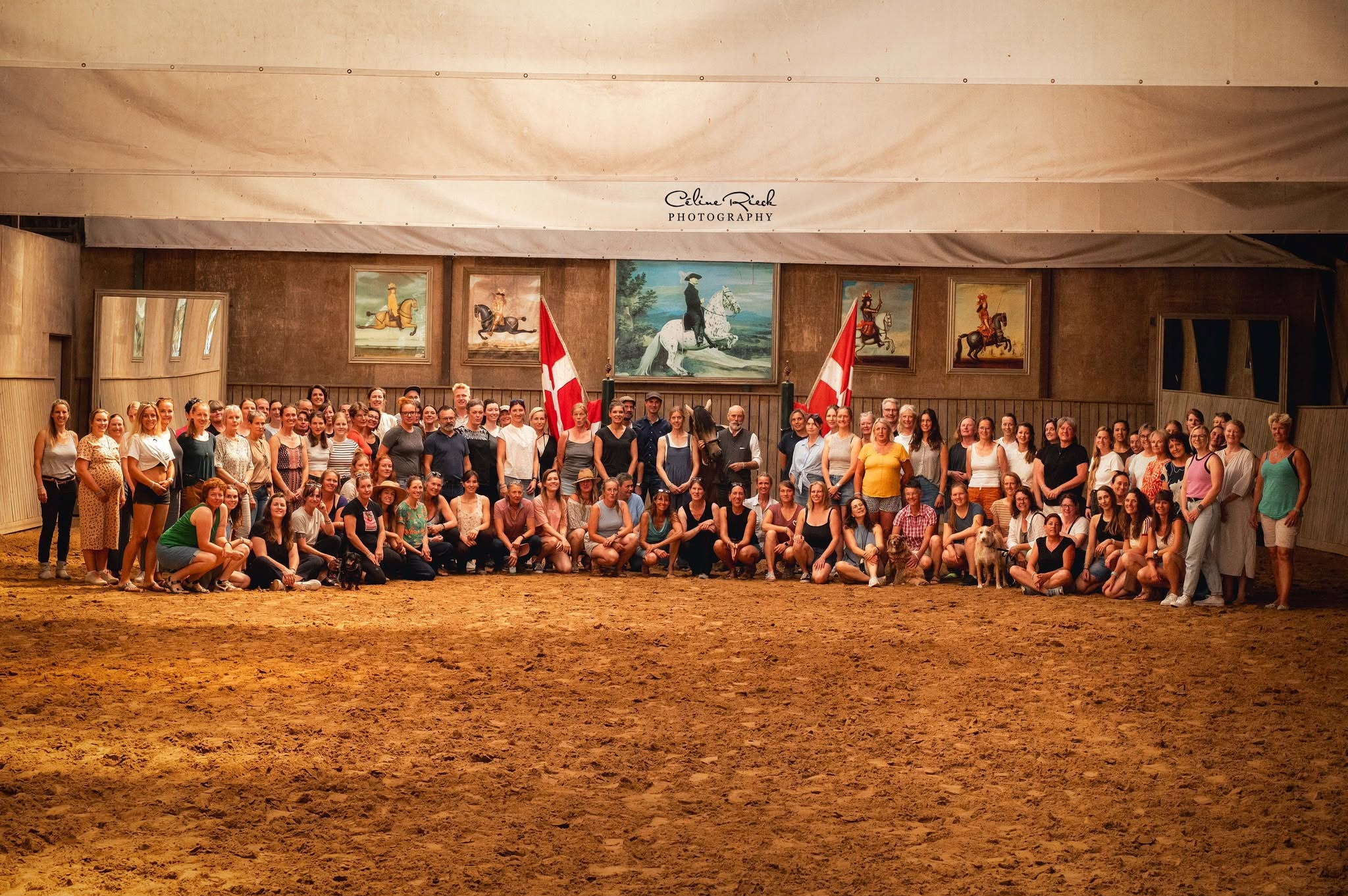
Once a year, the members of the Knighthood come together for the Summer Academy at Lindegaard, Bent and Kathrin Branderup’s home in Denmark. For several days, we study, exchange ideas, watch horses and riders, listen to lectures, discuss the work and simply spend time well. It is part seminar, part research meeting, part general assembly – and part family reunion for a rather international family whose members are perfectly happy to discuss the finer points of the rider’s pelvis over dinner.
Each Summer Academy has a central subject. Over the years, we have studied topics such as the seat, the secondary aids and the bending of the haunches. Bent and Kathrin show their current work with their own horses, and members contribute lectures, practical demonstrations and workshops. There is usually a “brain pool”, too: we separate into smaller groups, examine one aspect of the subject and then bring our thoughts back to the whole academy.
This is one of the things that makes the Summer Academy so special. It is not a place where one person stands at the front and delivers the final truth while everybody else takes notes. Bent founded the Knighthood as an international academy for research, exchange and education. Its members are meant to form a brain pool: bringing together historical sources, modern knowledge, practical experience and new questions, and helping one another to develop. I think the Academic Art of Riding was able to develop so much in the last decade because of the input of the whole knighthood, because it stands of many feet and thinks with many heads.
Of course, this does not mean that every idea is automatically a good idea. We discuss, question and sometimes disagree. But we share a common foundation and enough practical experience to make those conversations meaningful. Everyone at the table has gone through the tests and has shown that they can work with a horse at a substantial level. This creates a very different kind of exchange from an online discussion in which three strangers and somebody’s aunt confidently settle a complex training question before breakfast.
The formal conclusion of the Summer Academy is the Round Table. Here, new Squires and Knights are welcomed, members’ achievements are celebrated, current questions are discussed and decisions concerning the Knighthood are put to a vote. New members sign the Book of the Knighthood, receive their handcrafted wooden whip and silver whip decoration, and take their place at the table. It is a solemn ceremony and I always love the happiness everyone feels towards the new squires.
But when members speak about what they value most, it is often not only the official program. It is the possibility of meeting people from many countries who are occupied by the same questions. People who understand why a tiny change in a horse’s balance can keep you enthusiastic for several weeks.
There are conversations during meals, stories by the fireplace, ideas exchanged in the stable and friendships that continue across countries for many years. In my own report from one Summer Academy, I wrote that meeting old friends and making new ones was almost the most important part. The education matters enormously, but so does the feeling of belonging to a community in which people are not competing over who already knows the most. We come together because we are still learning.
Perhaps that is what I value most about the Summer Academy: you leave with more knowledge, but usually also with more questions. That may not sound very efficient, but in an art that is meant to accompany us throughout a lifetime with horses, it is probably exactly as it should be.
I briefly mentioned that we celebrate the members’ achievements. Beyond the Squire test, members can take six Gold Ring examinations: Bending of the Haunches, Piaffe and Passage, School Canter, Levade, Terre à Terre and the Schools Above the Ground. The first Gold Ring, Bending of the Haunches, is also required before taking the Knight test, which includes riding one-handed as well as a theoretical examination.
A Knight who has passed all six Gold Ring tests may apply for the Master examination. This consists of a public lecture and a musical freestyle demonstrating the Knight exercises and the first three Gold Rings. So becoming a Master requires rather more than collecting enough rings to make the silver whip decoration look impressive.
I think that, in the times we live in, the Knighthood is something extremely valuable. Today, anyone can proclaim themselves a master, and almost anyone can look impressive on social media. A well-chosen clip, a confident caption and the right music can create a great deal of authority in under thirty seconds.
The Knighthood offers something very unique It is a system of checks and balances, but also a place of support. We share our successes, our questions and our doubts – and we all have plenty of those. Most of us stay in close contact with other members throughout the year, whether they are our teachers, colleagues or friends.
We study certain subjects in great depth, and because there are so many of us, the Knighthood has become a mountain of practical experience and knowledge. Whatever your question, there is probably someone who has studied it closely. And not only as a specialist in one narrow field, but as an experienced horse person who has educated horses to a very high level.
That combination is so important. Social media is full of strong opinions, but not always of people who have actually trained a horse through the long, difficult and sometimes very humbling process that lies behind advanced work.
After this year’s Summer Academy, as after every Summer Academy, I feel deeply proud to be a member of this community – and grateful that I was able to contribute my own small part to this year’s program.
Perhaps, one day, your own road of learning will lead you to take your place at the Round Table.
This year’s group photo of the knighthood by Céline Rieck Photography


